A sad day to the footballing world as the we announce the demise of ATSU the Ghanian international footballer and former Newcastle United player. The recent devastating earthquake that hit Syria and Turkey is the main cause of his untimely death. The body of the Ghanian international footballer was in search all these days but later found under rumble. Condolences to his family. RIP LEGEND
Is teenage pregnancy in Kenya really on the rise?

A controversy is raging in Kenya about teenage pregnancy.
The debate was sparked following comments made by Education Secretary Amina Mohamed, who said that a "high number of candidates became mothers" during three days of the Kenya Certificate of Primary Education (KCPE) exams - sat by pupils normally aged 13 or 14.
She said: "If this is happening all-year round, the country could be facing a real crisis."
This has led to debates online and on radio and television, and sparked a wave of media reports from around the country.
Reality Check has investigated the available data on teenage pregnancy to see whether it is in fact on the rise in Kenya.
We have also uncovered one widely-shared post on social media that has perpetuated a false claim of girls breastfeeding during exams.

False claims
First, the claims about the girls breastfeeding at school.
The posts have appeared on social media platforms and are being shared by multiple Facebook accounts. Some of the pages have more than 150,000 followers.
Each post is being shared with the same photo - what appears to be a line of young women wearing blue uniforms, each carrying a baby.
There are no links to sources or published articles.
The use of the photo has led to confusion and outrage among social media users. One wrote: "What a shame is this? What are the reasons to this outcome? What is wrong with our moral standards?"
Others have doubted whether it is true, and they are right to be sceptical.
 AFP
AFP
The photograph first appeared in an online CNN article and it is not of mothers at a school in Kenya.
CNN has confirmed to Reality Check that the photograph was taken in Tanzania of young women walking children to a day care centre.
This same photo has been attached to a range of posts, all making similar claims about pregnancy in Kenyan schools.
Some posts claimed 19 out of 30 girls in the class were breastfeeding. Others said it was 21 out of 30 girls.
We also looked into the school frequently named in the posts and found that Chabera Mixed Secondary, Nyanza does not exist.
We asked a local reporter for the BBC to go to the area to check, and although there is a secondary school in Chabera, it has a different name and there was no evidence to support the claims.
Facts about teenage pregnancy
The recent debate in Kenya about the rates of teenage pregnancy has been clouded by social media posts such as these.
But there is widespread concern about the issue.
"Teenage pregnancy is not a new phenomenon in Kenya," says Elizabeth Muiruri, of Save the Children. "However, the recent media coverage of several girls who delivered during the three days of primary exams that transitions them to high school has been alarming."
The BBC has interviewed schoolteachers and education and health officials in Kisumu county and neighbouring areas in the western region. They expressed concern at what they said was a rise in the number of teenage pregnancies, including girls under the age of 15.
They cited the causes as high levels of poverty, a lack of sex education and gender inequality.
Between July 2016 and June 2017, the Kenyan ministry of health recorded almost 350,000 pregnancies among young women aged between 15 and 19.
This counts pregnant women who go to health facilities for pre-natal and ante-natal care, so does not capture those who do not seek help at a hospital, which means the overall figure could be significantly higher.
And, according to the last Kenyan government health survey conducted in 2014,18% of women aged between 15 and 19 were mothers or pregnant with their first child.
But to compare teenage pregnancy over time and across countries, the United Nations uses rates per 1,000.
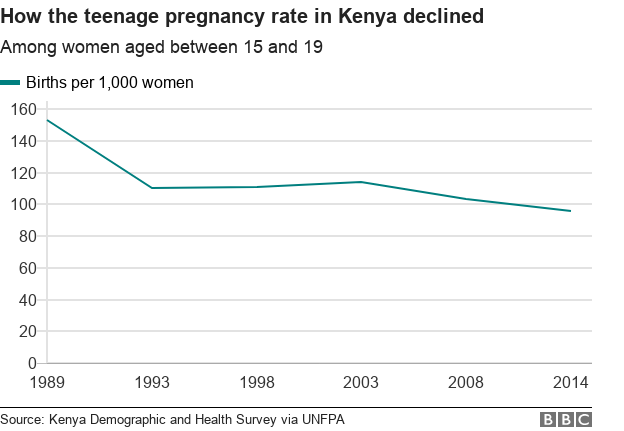
According to the UN Population Fund (UNFPA), which uses Kenyan health survey data, the rate for births among women aged 15 to 19 was 96 per 1,000 women in 2014.
But this data also clearly shows a significant falling trend in pregnancy rates, from a high of 153 per 1,000 in 1989 - a drop of one-third.
This can be attributed to sex education in schools, better awareness of contraceptives and improved prosecution of perpetrators, says Fredrick Okwayo, an adviser at the UN Population Fund.
However the absolute number of girls involved is still "huge" and "in some cases this leads to the affected girls to miss their opportunities in life".
How does Kenya compare?
Some other African countries, including Nigeria and Tanzania, have higher rates, according to data compiled by the World Bank, while South Africa has a lower rate. All have shown significant declines over the past 30 years.
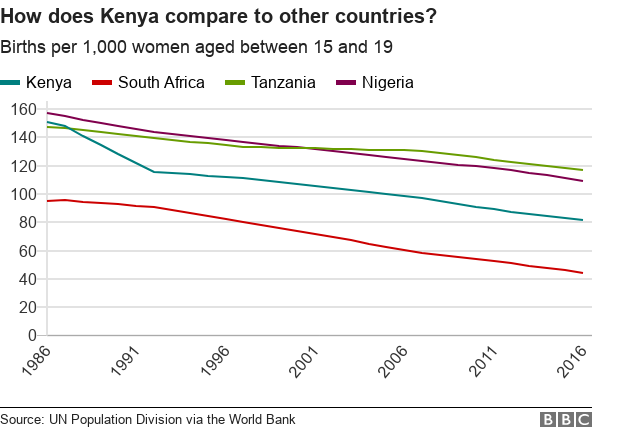
Despite the lack of evidence to suggest increasing teenage pregnancy rates in Kenya, and levels comparable with other African countries, there is no doubt that the issue is of great concern to many in Kenya and has prompted government action.
The next government health survey aims to determine the extent of the problem in more detail and whether the most recent claims of a rise in pregnancies is borne out.

Comments
Post a Comment